The term “silver business” covers many different ventures. It can mean reselling silver jewellery from home, building an online private-label brand, running a silver wholesale supply operation for retailers, or manufacturing silver ornaments for other sellers. Each of these paths needs a different budget, skill set and way of working.
This guide is written for new silver business owners, jewellery retailers, resellers, wholesalers, online sellers, boutique owners, manufacturers, gift businesses and other Indian B2B buyers who want a clear, honest picture of how a silver business actually works — from sourcing and pricing to compliance and day-to-day operations. Wherever this guide gives a number, treat it as a planning example, not a promise.
Is a Silver Business Profitable?
A silver business can be profitable, but profit depends on your model, your costs and how well you manage stock. There is no fixed margin that applies to every seller. Anyone who promises a guaranteed profit percentage or income figure is not giving you an honest picture.
Where the profit actually comes from
Profit in a silver business usually comes from three places: the making or design value added to raw silver, the difference between your buying price and selling price, and repeat orders from customers who trust your quality and service. Pure metal weight alone rarely carries a strong margin — design, finishing and trust are what allow a seller to charge above the metal cost.
Gross margin versus net profit
Gross margin is what is left after subtracting only the product or silver cost from your selling price. Net profit is what is left after every other cost is subtracted too — making charges, packaging, shipping, returns, payment gateway fees, advertising, rent, salaries, taxes and interest on borrowed money. Many sellers look only at gross margin and assume that is their profit. It is not. Always check net profit before deciding a model works for you.
Costs that reduce actual profit
- Silver price movement between the time you buy stock and the time you sell it
- Returns and exchanges, which are common in jewellery
- Payment gateway and marketplace commission fees
- Advertising cost to acquire each customer
- Packaging, courier and reverse-shipping cost
- Slow-moving or unsold stock tying up cash
Which Silver Business Model Should You Choose?
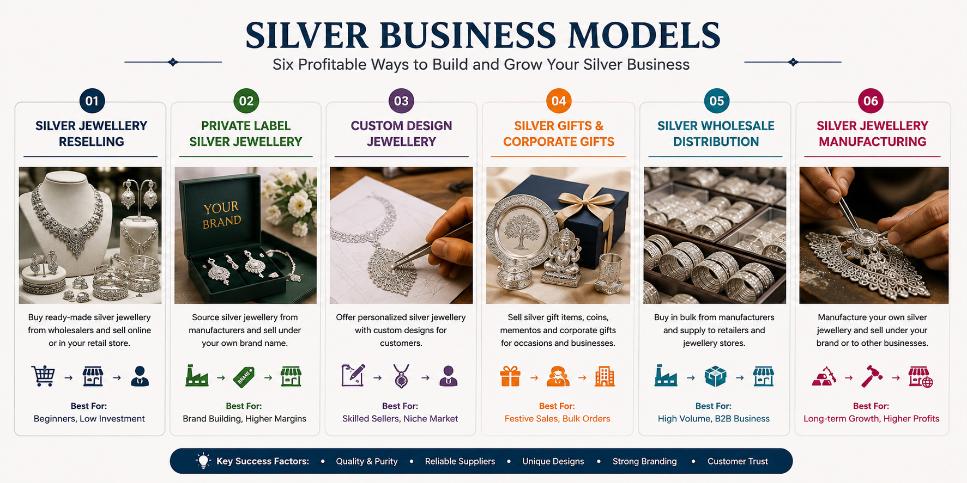
Before you approach any silver supplier, decide which model fits your budget, skills, target buyer and how much inventory risk you can accept. The table below compares the common models at a glance.
Model | Starting Budget | Target Buyer | Inventory Risk | Skill Level | Sales Channel | Key Challenge |
Jewellery resale | Low | Individual shoppers | Low–Medium | Beginner | Instagram, WhatsApp | Thin margins, competition |
Private-label brand | Medium | Online buyers | Medium | Beginner–Intermediate | Website, marketplaces | Building brand trust |
Custom jewellery | Low–Medium | Individual, gifting | Low | Intermediate | Website, referrals | Longer production time |
Ornaments and gifting | Medium | Corporates, individuals | Medium | Beginner–Intermediate | Website, B2B outreach | Seasonal demand |
Coins and bars | Medium–High | Investors, gifting buyers | Medium | Intermediate | Retail counter, online | Price sensitivity, storage |
Wholesale supply | High | Retailers, boutiques | High | Intermediate–Advanced | B2B outreach, exhibitions | Large capital, MOQ |
Manufacturing | High | Wholesalers, brands | High | Advanced | B2B, trade shows | Skilled labour, equipment |
A short note on each model:
Silver jewellery resale
You buy finished jewellery from a supplier and sell it directly, often online. Low starting cost, but margins are thin because you are not adding design value.
92.5% purity private-label brand
You source finished pieces at high-purity silver and sell them under your own brand name, with your own packaging and photography. This needs more upfront investment in branding but can support better margins.
Custom silver jewellery
You take individual orders — name jewellery, personalised gifts — and get them made to order. Inventory risk is low because you are not holding finished stock, but production time is longer.
Silver ornaments and gifting
You sell idols, décor pieces, corporate gifts and festive items. Demand is often seasonal, so cash flow planning matters.
Silver coins and bars
You sell investment-style silver products. Buyers compare prices closely, so margins are usually lower and storage/security matter more.
Wholesale supply to retailers
You buy in bulk and supply retailers or boutiques. This needs the most capital and the strongest supplier relationships, but order sizes are larger.
Silver jewellery manufacturing
You produce jewellery yourself using skilled karigars (craftsmen) and equipment. This is the most capital- and skill-intensive model, but it gives you the most control over quality and cost.
How Much Investment Is Needed to Start a Silver Business?
There is no single “correct” number for starting a silver business — it depends heavily on your model, city and how much stock you carry. Instead of one headline figure, break your budget into inventory, samples, packaging, marketing and working capital. The ranges below are planning examples only.
Model | Inventory | Samples | Packaging | Marketing | Working Capital |
Home-based resale | Low | Low | Low | Low–Medium | Low |
Online / private label | Medium | Medium | Medium | Medium–High | Medium |
Wholesale model | High | Medium | Low–Medium | Medium | High |
Physical retail store | High | Low | Low | Medium | High |
Home-based resale
You keep a small rotating stock and sell through WhatsApp and Instagram. This is the easiest entry point and lets you test demand before scaling.
Online or private-label model
You need budget for product photography, packaging design, a website or marketplace listings, and paid marketing to acquire your first customers.
Wholesale model
Most of your budget goes into inventory because suppliers usually require a minimum order quantity (MOQ). Working capital needs to cover the gap between paying your supplier and getting paid by retailers.
Physical retail store
On top of stock, you carry rent, staff salaries, security and store fit-out costs. This model has the highest fixed cost and needs the strongest cash flow planning.
How to Start a Silver Business Step by Step
- Choose a niche — jewellery, ornaments, gifting, coins, or a specific product category, rather than trying to sell everything at once
- Validate demand — check search interest, ask potential buyers, and look at what similar sellers already do well or poorly
- Find suppliers — shortlist a few verified suppliers or manufacturers and compare their terms, not just their prices
- Order samples — test finish, weight accuracy and purity claims before placing a bulk order
- Check purity and documents — ask for purity certification or hallmark details and keep supplier invoices on file
- Start with limited stock — buy a small first batch so you are not carrying large amounts of unsold inventory
- Set pricing — build your price from total landed cost, not just the quoted product price
- Choose sales channels — pick one or two channels to start (for example, Instagram and WhatsApp Business) rather than spreading thin
- Track cash flow and reorder — reorder based on what has actually sold, not on assumptions about demand
How to Buy Silver Wholesale
Buying wholesale is not only about getting the lowest quoted price. A few details decide whether an order is actually good value.
MOQ and sample orders
Most wholesale suppliers set a minimum order quantity (MOQ) — the smallest amount you must buy in one order. A lower MOQ reduces risk for a beginner because it limits how much cash and stock you commit before you know what sells.
Silver weight and purity
Confirm both the exact weight per piece and the purity level before ordering. Weight and purity together decide the real metal value — a lighter piece at the same price is not the same value as a heavier one.
Making charges
This is the labour and design cost added on top of the metal value. Making charges vary by design complexity and by supplier, so compare them separately from the metal price.
Stones and plating
If a piece has stones or a plated finish, ask how this affects price, durability and any care instructions you should pass on to your customers.
GST and invoice details
Insist on a proper GST invoice for every order. This protects you legally and is needed if you sell as a registered business.
Shipping and return terms
Confirm who pays for shipping, how damaged or incorrect items are handled, and what the supplier’s return window looks like before you place a large order.
Total landed cost is the real number to compare between suppliers — it means the product price plus making charges, shipping, packaging and any other charges added before the item reaches you. Comparing only the quoted product price can be misleading.
How to Find Reliable Silver Suppliers and Manufacturers
Use this checklist to compare suppliers on more than just price.
Check Point | What to Look For |
Business identity | Registered business name, GST number, physical address |
Sample quality | Order a sample before a bulk order; check finish and consistency |
Purity information | Purity grade stated clearly, ideally with hallmark or test report |
Weight accuracy | Weigh sample pieces yourself against the supplier’s stated weight |
Documentation | Proper GST invoice for every transaction |
MOQ | Minimum order size that matches your budget and risk level |
Lead time | How long production and delivery actually take, in writing |
Repeat-order consistency | Whether quality and weight stay consistent on the second and third order |
Return terms | Clear policy for damaged, incorrect or defective items |
A supplier badge, certificate or marketplace rating is useful context, but it is not proof of product quality on its own. Test samples yourself, and consider independent testing or recognised certification when purity really matters for your business.
Silver Purity, Hallmarking and Compliance
What high-purity silver means
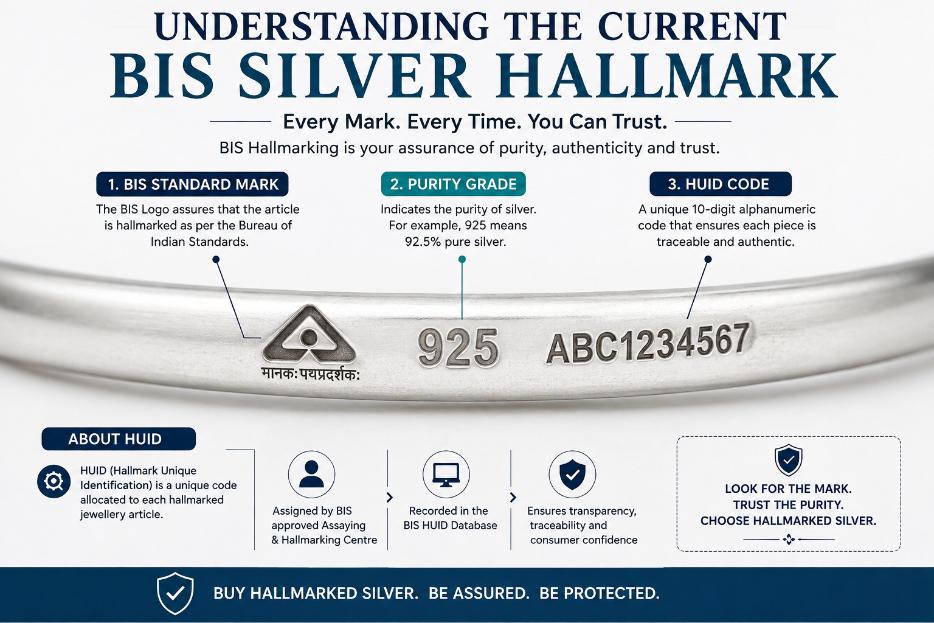
Fine jewellery-grade silver is usually 92.5% pure silver alloyed with other metals for strength, since pure silver on its own is too soft for everyday jewellery. India’s revised hallmarking standard, IS 2112:2025, recognises several purity grades for silver, so always confirm which grade you are buying and check it against the hallmark or supplier documentation.
What a silver hallmark tells you
A hallmark issued under the current framework shows the purity grade and a Hallmark Unique Identification (HUID) code, which buyers can check through the BIS Care mobile app. It is meant to confirm article type, purity grade, hallmarking date, testing centre and jeweller registration.
BIS registration and hallmarking
The Bureau of Indian Standards (BIS) is the official body for hallmarking in India. As of this guide’s publication, silver hallmarking overall remains voluntary nationwide, unlike gold hallmarking, which is mandatory in many districts. This can change, so always verify the current position on the official BIS website before publishing pricing or compliance claims.
Current HUID framework
Since September 2025, any silver jewellery or article that a jeweller chooses to hallmark must carry a HUID code under the revised IS 2112:2025 standard — the older four-mark system is no longer used for new hallmarking. BIS has indicated it is working toward a mandatory framework for silver over time, but had not set a mandatory date as of this guide’s research. Confirm the latest position on the official BIS hallmarking pages before relying on this for compliance decisions.
How to Calculate Silver Business Profit
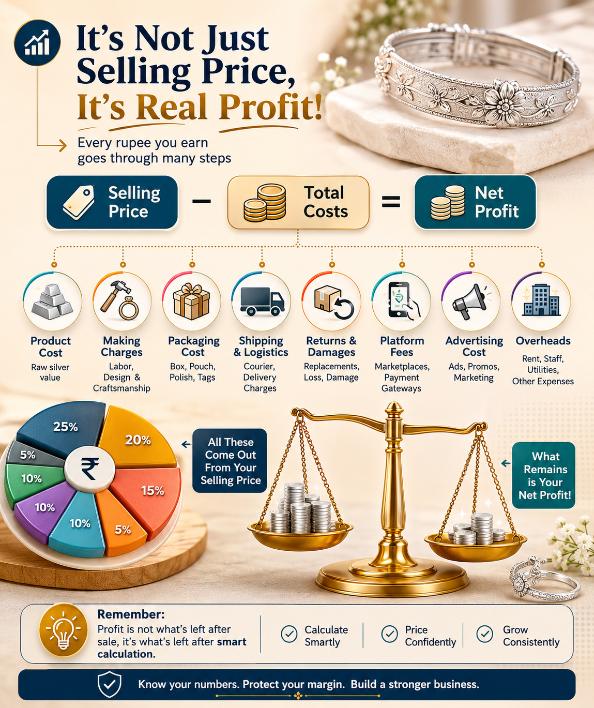
A transparent profit example, deducting all major costs, looks like this for one illustrative piece. Treat every figure below as an example only — your real costs will differ by product, supplier, city and channel.
Cost Item | Example Amount (₹) | Note |
Selling price | 3,000 | Price charged to the customer |
Silver / product cost | 1,600 | Metal value plus supplier’s base price |
Making charges | 300 | Labour and design cost |
Packaging | 60 | Box, pouch, tags |
Shipping (outward) | 80 | Courier cost to customer |
Gross margin | 960 | Selling price minus product, making, packaging, shipping |
Returns / exchange provision | 90 | Estimated share of orders returned |
Payment gateway fees | 60 | Card/UPI/wallet processing charge |
Advertising cost per order | 180 | Estimated customer acquisition cost |
Share of rent, salaries, taxes, interest | 250 | Apportioned overheads |
Estimated net profit | 380 | Gross margin minus all remaining costs |
Notice how much of the gross margin is absorbed by returns, fees, advertising and overheads. This is why checking net profit — not just gross margin — is essential before deciding a product or channel is working.
How Silver Price Changes Affect Your Business
When Silver Price… | What to Review |
Rises | Reprice unsold stock carefully; consider smaller, more frequent reorders; watch demand for price-sensitive products |
Falls | Avoid overstocking on the assumption prices will keep falling; review margins on stock bought at higher rates |
Stays stable | Good window to plan slightly larger reorders and lock in supplier pricing where possible |
Inventory risk
Silver is a traded commodity, so its price moves daily. Stock bought at one price and sold weeks later can carry a different margin than planned — in either direction.
Demand and price sensitivity
When silver prices rise sharply, some categories — especially jewellery — can see softer demand as buyers postpone purchases. Investment-style products like coins and bars can behave differently from jewellery demand.
Pricing and reorder decisions
Review your prices regularly rather than fixing them for long periods, and base reorder quantity on actual recent sales rather than on how the price is moving
Silver Market in 2026: What the Data Shows
The points below are dated market observations, not investment advice or a price forecast. Silver prices and market conditions change quickly, so verify current figures before publishing or relying on them.
Data Point | Detail | Source / Date |
Global silver supply | Forecast to rise about 1.5% in 2026 to roughly 1.05 billion ounces | Silver Institute, World Silver Survey 2026 |
Market balance | Forecast to remain in deficit for a sixth consecutive year, at about 67 million ounces | Silver Institute, World Silver Survey 2026 |
Physical investment demand | Forecast to rise about 20% in 2026 to roughly 227 million ounces | Silver Institute, World Silver Survey 2026 |
Global jewellery demand | Forecast to fall more than 9% in 2026 to about 178 million ounces, with India among the markets affected by high prices | Silver Institute, World Silver Survey 2026 |
Indian industrial silver demand | Fell about 10% year-on-year in 2025 to roughly 38.1 million ounces | Silver Institute, World Silver Survey 2026 |
Indian silver price | Widely reported in the range of roughly ₹2.2–₹2.5 lakh per kg in mid-August 2026, varying by source and city | Indian financial/rate-tracking sources, mid-August 2026 — verify live rate before use |
Silver hallmarking status | HUID-based hallmarking under IS 2112:2025 in effect since September 2025; overall silver hallmarking remains voluntary nationwide as of this guide’s research | Bureau of Indian Standards — verify current status before publication |
The overall pattern worth noting: supply is growing modestly, the market is expected to stay in deficit, investment demand is rising, and jewellery demand is under pressure from higher prices — including in India. None of this predicts where prices will move next; it is background context for planning stock and pricing decisions, not a signal to buy or sell.
Best Silver Products to Sell
Product Category | Stock Risk | Design Value | Shipping Ease | Repeat-Purchase Potential |
Daily-wear jewellery | Medium | Medium | Easy | High |
Rings, earrings, chains, anklets | Medium | Medium–High | Easy | High |
Custom name jewellery | Low | High | Easy | Medium |
Silver idols and puja products | Medium | Medium | Moderate (fragile) | Medium |
Corporate and festive gifts | Medium–High | Medium | Moderate (bulk) | Seasonal |
Coins and bars | High (price-sensitive) | Low | Needs secure packaging | Medium |
Where to Sell Silver Products
Website
Gives you full control over branding, pricing and customer data. Needs clear product photos, weight and purity details, care instructions and a visible returns policy to build trust.
Instagram and WhatsApp Business
Low-cost channels that work well for daily-wear jewellery and custom orders, especially for reaching individual buyers directly.
Local retailers
A route for wholesale and manufacturing models to place stock with jewellery shops and boutiques in exchange for regular repeat orders.
Exhibitions
Useful for building B2B relationships, testing new designs and meeting retailers face-to-face before committing to larger supply agreements.
B2B wholesale
Connecting suppliers with retailers directly, often through referrals, trade shows or supplier directories, remains one of the most reliable ways to build steady order volume.
Sourcing Silver Through Hari Silvears
Whichever model you choose, sourcing is one of the biggest decisions in a silver business. Hari Silvears works as a silver business and sourcing option for retailers, resellers and B2B buyers looking for silver jewellery, ornaments and wholesale products. As with any supplier, apply the same checks covered in this guide — sample testing, purity information, weight, invoicing and clear terms — before placing a bulk order.
If you are exploring silver jewellery, silver ornaments or wholesale sourcing options, you can explore the Hari Silvears product range or get in touch to discuss your specific wholesale requirements.
Answers to Common Wholesale Buyer Questions
How to start a silver business in India?
Choose a niche, validate demand,
find a verified supplier, order samples, check purity and documents, start with
limited stock, set pricing from total landed cost, and reorder based on actual
sales.
How much profit is in a silver business?
This varies widely by model, product and channel. Use a full cost breakdown — product cost, making charges, packaging, shipping, returns, fees, advertising and overheads — to estimate net profit for your own numbers.
Where can I buy silver in bulk?
Verified wholesale suppliers and manufacturers, often found through B2B directories, trade exhibitions and referrals, are common sources. Always verify business identity and test samples before a bulk order.
How do I find reliable silver suppliers?
Check business identity and GST details, test samples, confirm purity documentation and weight, review lead time, and see if quality stays consistent across repeat orders.
Where can I find silver wholesalers near me?
Local jewellery markets, trade exhibitions and B2B sourcing platforms are common starting points; combine this with the supplier checklist in this guide before committing to an order.
What should I check before buying high-purity silver wholesale?
Confirm the exact purity grade, piece weight, making charges, GST invoice, and return terms, and test a sample before ordering in bulk.
Is wholesale silver jewellery a good business?
It can work well for those with sufficient capital and strong retailer relationships, but it carries higher inventory risk and needs careful supplier verification and cash flow planning.
How can manufacturers find retail buyers?
Trade exhibitions, B2B sourcing platforms and direct outreach to retailers and boutiques are common ways manufacturers connect with buyers.
How can retailers find silver wholesalers?
Retailers can look at verified wholesale suppliers, industry directories and exhibitions, applying the same supplier checklist covered in this guide.
How can I start an online silver jewellery business?
Pick a niche, source from a verified supplier, invest in clear product photography and honest weight/purity details, choose one or two sales channels to begin with, and track sales before scaling.
How much silver stock should a beginner buy?
Silver price movement, slow-moving stock, unclear supplier terms, returns and exchanges, and pricing from gross margin instead of net profit are common risk areas.
How can I compare two silver suppliers?
Compare total landed cost, MOQ, purity documentation, weight accuracy, making charges, lead time and return terms side by side, not just the headline product price.
What are making charges in silver jewellery?
Making charges are the labour and design cost added on top of the raw silver value, and they vary by design complexity and by supplier.