
Ask three jewellers about the purity of silver and you’ll get three different answers.
One says “pure silver.” Another says “92.5.” The third taps a tiny stamp and moves on.
Here’s the short version. Purity of silver is the share of pure silver in an item, counted in parts per 1,000. A 925 mark means 925 parts silver and 75 parts other metal, usually copper.
The catch: anyone can stamp 925 on anything. What you can actually trust is a BIS hallmark with a six-character HUID code you can verify on your phone.
In this guide you’ll get the full silver purity chart, the 2025 rule changes most blogs still get wrong, five home tests (and exactly where they fail), and the one check that settles it in under a minute.
We’re Hari Silvears, a silver manufacturer in Madurai since 1963. This guide comes from the supply side of the counter, not a brochure.
Quick answers • 999 = 99.9% fine silver. Soft. Used for coins and bars. • 925 = 92.5% sterling silver. The jewellery standard. • 800 = 80% silver. Utensils and heavy-use articles. With 925, it makes up nearly 95% of hallmarked silver in India. • Only a BIS mark + SILVER + grade + HUID is verifiable. A plain “925” stamp is just a claim. • Home tests catch fakes, not exact purity. Use BIS Care or a lab for certainty. |
What Is the Purity of Silver?
Silver purity is measured as fineness: parts of pure silver per 1,000 parts of metal. Traders also call it the “touch” or the “mark.”
The maths takes ten seconds:
- 999 ÷ 1,000 = 99.9% silver
- 925 ÷ 1,000 = 92.5% silver
- 800 ÷ 1,000 = 80% silver
So why not make everything 100% pure? Because pure silver is soft enough to bend in your hand. Mix in a little copper and a chain holds its clasp, a ring keeps its shape, and a payal survives years of daily wear.
That’s the first thing to understand. Higher purity isn’t automatically better. It’s about the job the piece has to do.
Silver Purity Chart: Every Grade at a Glance
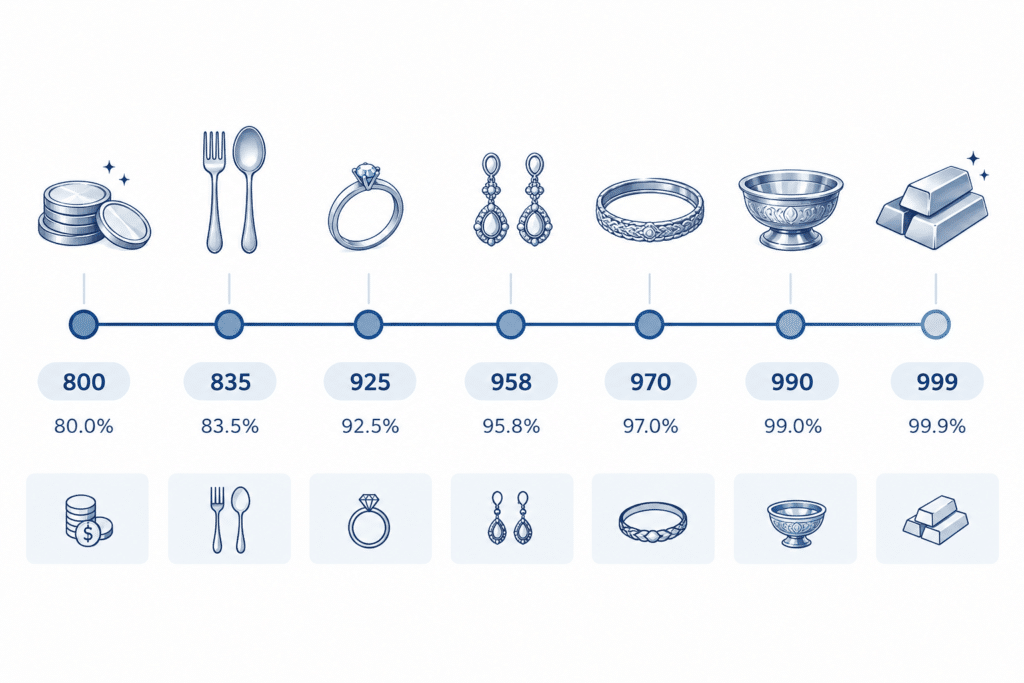
India’s current standard, IS 2112:2025, recognises seven grades: 800, 835, 925, 958, 970, 990 and 999. The older IS 2112:2014 standard allowed six, including 900. The revision added 958 and 999 and dropped 900, according to PTI.
Found “900” or “coin silver” on an older piece? It isn’t fake. It simply comes from the earlier system.
Highest Purity of Silver: Is 999 Always Best?
The highest purity of silver sold commercially is 999 (99.9%), known as fine silver. Some refiners go further and stamp 999.9 on bullion, but that sits outside the BIS jewellery grades.
Is it the best? That depends on what you’re buying:
- Investing or storing value: Almost every gram is silver, so pricing is simple.
- Wearing daily: It’s hard enough to survive clasps, settings and knocks.
- Utensils and heavy-handling articles: 800 or 835. Harder again.
Our rule of thumb: wear 925, hold 999.
Purity also drives price. The maths is net silver weight × purity × the day’s rate, so a 925 piece is valued at 92.5% of the fine-silver rate for the same weight. If a 925 article is priced far below that, either the weight or the purity isn’t what the label claims.
925 vs 999 vs 958: Your Questions, Answered
Which is pure silver, 925 or 999?
It’s 99.9% silver, so it’s the purer metal. But “pure” and “better” aren’t the same thing. 999 scratches, dents and bends easily, which is why it’s used for coins and bars, not everyday jewellery.
Is 925 silver good quality?
Yes. 925 sterling is the international benchmark for quality jewellery. It will tarnish over time because the copper in it reacts with sulphur in the air. That’s cosmetic, and a soft polishing cloth removes it.
Which is better, 925 or 958?
958 (Britannia) is slightly purer and slightly softer. BIS added it in 2025, but 925 remains the practical choice for jewellery. BIS reports that 925 and 800 together account for nearly 95% of hallmarked silver articles, so 958 is a niche grade.
Is 100% silver better than 925?
True 100% silver isn’t sold commercially. 999 is as pure as it gets, and it’s too soft for most jewellery. For daily wear, 925 wins on durability.
What is “70” purity silver?
You may hear “70 silver” in the market, especially with low-priced payals and fashion pieces. In the trade it generally means an alloy of roughly 70% silver. That’s below the lowest BIS grade (800), so it can’t carry a BIS silver hallmark. It isn’t automatically dishonest, but price it accordingly and get the purity claim in writing.
Purity of Silver in India: The BIS Hallmark Explained
A hallmark isn’t something a jeweller stamps in the back room. It’s applied after a BIS-recognised Assaying and Hallmarking Centre (AHC) has tested the metal. Since 1 September 2025, hallmarked silver carries three marks:
- BIS Standard Mark with the word SILVER.
- Purity grade, such as 925 or 999.
- HUID: a laser-marked, six-character alphanumeric code unique to that single article.
The HUID is the game changer. Enter it in the BIS Care app and you can see the article type, purity grade, hallmarking date, testing centre and jeweller registration number for that exact piece.
The numbers show buyers are switching on. According to BIS data reported in August 2026:
- More than 77 lakh silver pieces have been hallmarked with HUID since September 2025, reports Deccan Herald. The year before, about 32 lakh were hallmarked without one.
- BIS now lists 341 silver Assaying and Hallmarking Centres across 102 districts, up from about 230 across 87 at launch, per All India Radio.
- More than 25,000 silver jewellers have registered with BIS.
- The southern region accounts for 62% of silver hallmarking, ahead of the west (18%) and the central region (10%), according to BIS figures.
Is it mandatory?
Not yet. Silver hallmarking has been voluntary since 2005. If a jeweller does hallmark silver, a HUID is now required. In June 2026 the BIS Director General said mandatory silver hallmarking will come gradually, with no firm date. Our full breakdown is in Silver Hallmarking in India.
Silver Purity Mark: Where to Find It on Your Piece
The marks are tiny. Use your phone camera at full zoom, then pinch-zoom the photo.
• Chains and necklaces: on the clasp or a small tag near it.
• Rings and bangles: inside the band.
• Anklets and payals: on the clasp plate or end link.
• Coins: on the reverse face or edge.
• Bars: on the flat face.
• Pooja articles and utensils: usually the base, sometimes the rim.
Remember the difference. A bare “925” stamp is a maker’s claim. A BIS mark with a HUID is a lab result.
How to Check Silver Purity at Home: 5 Quick Tests
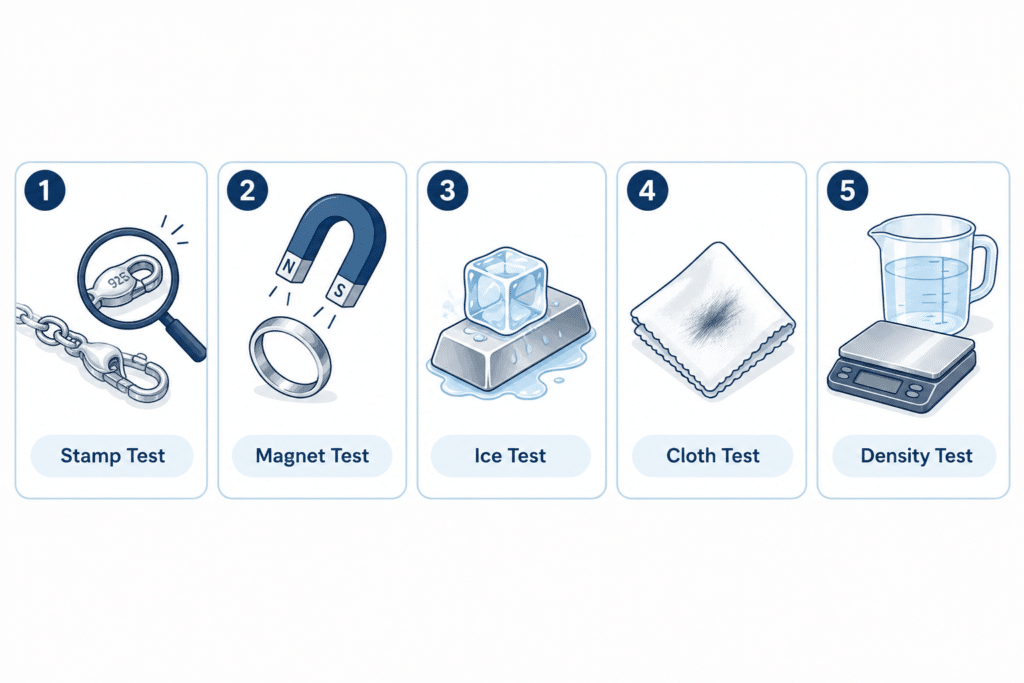
Home tests can weed out obvious fakes. None of them can tell 925 from 900 or 835. Treat them as a first filter, not a verdict.
- Read the stamp. Look for 925, 999 or 800, then look for the BIS mark and HUID. A stamp alone proves nothing, because stamps can be copied.
- Magnet test. Silver isn’t strongly magnetic. If a strong magnet grabs the piece, it contains iron or nickel. Passing doesn’t prove it’s silver, because brass, copper and aluminium aren’t magnetic either.
- Ice test. Silver has the highest thermal conductivity of any metal, so ice melts noticeably faster on it. Compare against another metal object of similar size. Copper and aluminium conduct heat well too, so this is a clue, not proof.
- Cloth test. Rub the piece with a soft white cloth. A grey or black smudge is typical tarnish on silver alloys. A clean cloth doesn’t prove a fake, since 999 tarnishes far less. Use it as a hint only.
- Density test. Pure silver weighs about 10.49 g per cm³, and sterling is close to 10.4. Weigh the piece, measure its volume by water displacement, then divide. A big mismatch points to plating or a hollow build.
Skip home acid and scratch kits unless you’ve been trained. The chemicals are corrosive and can damage your piece.
How to Check the Purity of Silver Properly
Verify the HUID on BIS Care (free, about 60 seconds)
- Download the official BIS Care app from the Bureau of Indian Standards. Avoid look-alike apps.
- Find the six-character HUID on the piece.
- Open Verify HUID and enter the code.
- Read the result: article type, purity, date, testing centre and jeweller details.
- Match every detail against the piece in your hand and your invoice.
Get it tested
- XRF analysis: an X-ray fluorescence scanner reads the metal composition without damaging the piece. It measures the surface layer, so a good lab will also check for plating.
- Cupellation or wet-chemistry assay: the traditional reference methods. They need a small sample, so they’re usually kept for bars, bullion and disputes.
- Touchstone and acid test: quick, used by experienced jewellers, and leaves a tiny mark.
Checking 999 bars and coins
For fine silver, buy from established refiners and dealers, and check the refiner’s stamp, purity mark and serial number. A density check helps with solid bars. For anything high-value, get an XRF reading.
Purity of Silver by Article: Payal, Chains, Bracelets, Coins and Utensils
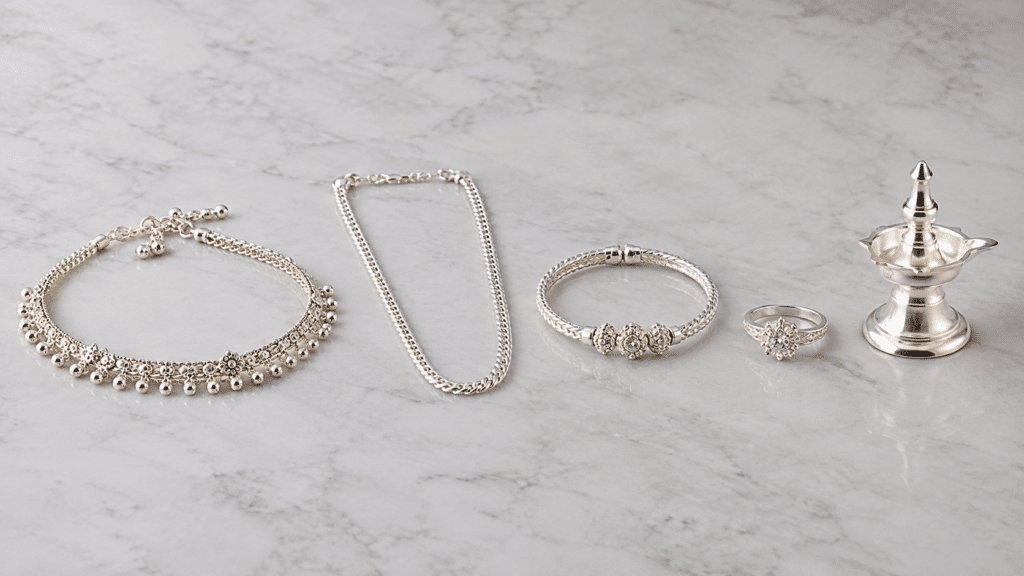
Article | Usual purity | Why |
925 (800 for heavier budget pieces) | Constant movement and friction. They need strength. | |
925 | Clasps and links need hardness. | |
925 | They bend and knock all day. | |
925 | Holds its shape and settings. | |
Silver coins | 999 | Stores value and is easy to price. |
800 to 835 | Heavy handling. Needs a harder alloy. | |
Pooja articles | 925 to 990 | Handled gently, so higher purity works. |
What We See on the Factory Floor
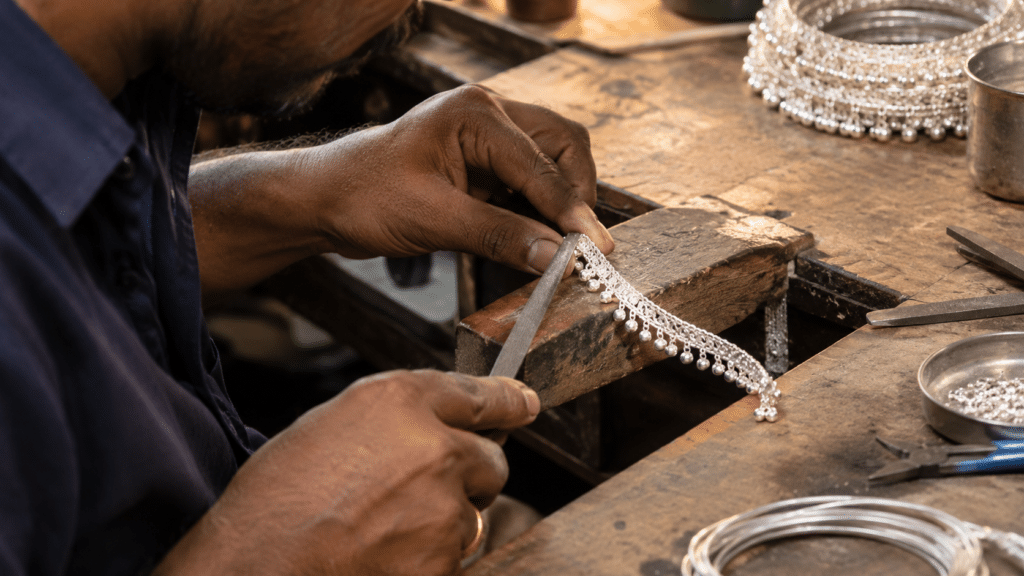
We’ve manufactured silver in Madurai since 1963 and supply more than 500 wholesale partners across 38 districts. Every month we send consignments to Assaying and Hallmarking Centres, so we see how purity is tested, not just how it’s advertised.
That matters in the South in particular. BIS data puts the southern region at 62% of India’s silver hallmarking, and Madurai’s silver trade has a long craftsmanship heritage behind it.
FAQs About the Purity of Silver
What is the purity of silver measured in?
Silver purity is measured in fineness, meaning parts of pure silver per 1,000 parts of metal. A 925 mark means 92.5% silver. It is often written as a percentage too.
What is the best purity of silver for jewellery?
925 sterling silver. It balances purity and strength, it is the standard jewellery grade worldwide, and it is the most common grade in India.
How do I check silver purity at home?
Read the stamp, then try the magnet, ice, cloth and density tests. These filter out obvious fakes but cannot confirm an exact grade. For certainty, verify the HUID on BIS Care or get an XRF test.
Is 925 silver real silver?
Yes. It is 92.5% pure silver with 7.5% other metal, usually copper. “Sterling silver”, “925” and “92.5%” all describe the same alloy.
What does the silver purity mark mean?
It tells you the fineness of the metal. On BIS-hallmarked silver it sits beside the BIS mark with the word SILVER and a six-character HUID code.
How do I check silver purity online in India?
Use the BIS Care app. Open Verify HUID, enter the code from the piece, and compare the details with the item and your invoice.
Is silver hallmarking mandatory in India?
Not as of early October 2026, going by the latest official statements we found. If a jeweller hallmarks silver, a HUID is required.
The Bottom Line
The purity of silver comes down to one number and one verification. Pick the grade for the job: 925 to wear, 999 to hold, 800 for everyday utensils. Then confirm it with a BIS mark and a HUID, not a stamp alone.
Want purity you can audit? Browse our wholesale silver collection or talk to our team about hallmarked bulk orders.