THE SHORT ANSWER Silver hallmarking in India is voluntary as of September 2026. It is not mandatory the way gold hallmarking is. But under IS 2112:2025, any silver a jeweller chooses to hallmark must carry three marks: the BIS logo with the word SILVER, a purity grade such as 925, and a six-digit HUID you can verify free on the BIS Care app. |
That one paragraph settles about 80% of the questions we get on the factory floor. The rest of this guide is for everything it does not cover.
We manufacture silver in Madurai and send consignments to Assaying and Hallmarking Centres every month. So this is written from the supply side of the counter, not from a press release.
Here is what changed, what it costs, and exactly how to check a piece before you pay for it.
What a BIS silver hallmark actually looks like
A hallmark is not a stamp a jeweller applies themselves. It is a certification applied at a BIS-recognised Assaying and Hallmarking Centre after the metal has been physically tested.
That distinction matters more than anything else in this guide. A “925” stamped by a workshop tells you what the maker claims. A BIS hallmark tells you what an independent lab measured.
The three marks on hallmarked silver
Since 1 September 2025, hallmarked silver in India carries three components:
- The BIS Standard Mark — the triangular Bureau of Indian Standards logo, shown alongside the word SILVER. This is the part that confirms a recognised centre tested the metal.
- The purity grade — a fineness number such as 925, expressed in parts per thousand. A grade of 925 means 925 parts out of 1,000 are pure silver.
- The HUID — a six-character alphanumeric Hallmark Unique Identification code. It is unique to that single article. No two pieces share one.
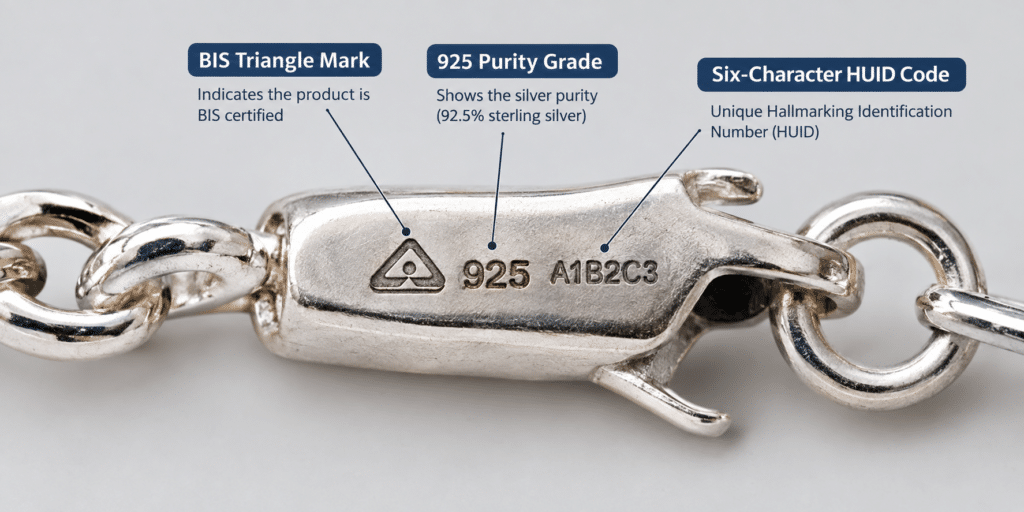
The HUID is the genuinely new part. It turns a physical stamp into a database record. Enter the code and you can pull up the article type, the purity grade, the hallmarking date, the testing centre and the jeweller registration number behind that specific piece.
Old 4-mark silver versus new 3-mark silver
If you own silver bought before September 2025, it will look different — and that is normal, not suspicious.
| IS 2112:2014 (until Aug 2025) | IS 2112:2025 (from 1 Sep 2025) |
Number of marks | Four | Three |
Marks shown | BIS logo, purity grade, AHC identification mark, jeweller identification mark | BIS Standard Mark with SILVER, purity grade, HUID |
Purity grades | Six: 800, 835, 900, 925, 970, 990 | Seven: 800, 835, 925, 958, 970, 990, 999 |
Digitally traceable | No | Yes, via BIS Care |
Still valid to own and sell | Yes | Yes |
Two grades were added in the revision — 958 and 999 — and grade 900 was removed from the list.
Older four-mark silver remains perfectly legitimate. You simply cannot look it up in the HUID database, because that database did not exist when the piece was marked.
Where the hallmark is stamped on different articles
You will need a magnifying glass or your phone camera on maximum zoom. The marks are deliberately small.
- Chains and necklaces — on the clasp or the small tag soldered near it.
- Rings and bangles — on the inner surface of the band.
- Anklets and payals — on the clasp plate or the end link.
- Coins — on the reverse face, or along the edge.
- Bars and biscuits — on the flat face.
- Pooja articles and utensils — usually on the base, sometimes on the rim.
The trick that works best: photograph the area at maximum zoom in good light, then pinch-zoom the photo. Far easier than squinting.
On our own pure silver range, the mark sits on the clasp for silver chains and silver anklets, and on the inner band for bangles and rings.
The seven silver purity grades under IS 2112:2025
Silver is too soft to wear in its pure form. Almost every wearable piece is an alloy — pure silver mixed with a small quantity of another metal, usually copper, for strength.
Fineness is simply how much of that alloy is silver, counted in parts per thousand.
Grade | Silver content | What it is typically used for |
999 | 99.9% | Fine silver. Coins, bars, investment articles. Too soft for daily-wear jewellery. Added in the 2025 revision. |
990 | 99.0% | Near-fine. Traditional pooja articles, some utensils. |
970 | 97.0% | High-purity articles and some heavy ornamental work. |
958 | 95.8% | Britannia-standard equivalent. Added in the 2025 revision. |
925 | 92.5% | Sterling silver. The global jewellery standard and the grade most Indian buyers will meet. |
835 | 83.5% | Harder alloy. Utensils, gift articles, heavy-use items. |
800 | 80.0% | Lowest recognised grade. Utensils, artefacts, structural silverware. |
925 vs 92.5 vs sterling silver: same metal, three names
This confuses more buyers than anything else, so let us kill it quickly.
- 925 — the fineness expressed in parts per thousand.
- 5 — the same number expressed as a percentage.
- Sterling silver — the traditional trade name for exactly that alloy.
They are identical. A piece marked 925 is 92.5% silver and is sterling silver. If a seller prices “sterling” above “925” as though one is superior, walk away.
Why 925 and 800 dominate the market
According to figures released by BIS in September 2026, grades 925 and 800 together account for close to 95% of every silver article hallmarked in India.
There is a practical reason. 925 is hard enough to hold a clasp, a setting and a polish for decades. 800 is harder still, which is why it turns up in utensils and articles that get handled daily.
The high grades — 990 and 999 — are beautiful but soft. We use them for coins, bars and certain devotional articles where the metal is not being flexed.
Is silver hallmarking mandatory in India? What most articles get wrong
No. As of September 2026, silver hallmarking in India is voluntary.
We are being blunt about this because a surprising number of well-ranked articles state the opposite — some claim silver above two grams must be hallmarked. That is not what the regulation says.
Here is the accurate sequence.
On 4 September 2025, the Ministry of Consumer Affairs announced voluntary hallmarking for silver jewellery and articles, effective from 1 September, built around a digital identification system. BIS published the revised IS 2112:2025 standard, replacing IS 2112:2014.
What became compulsory was not hallmarking itself. It was HUID. If a jeweller chooses to hallmark a silver article, that article must now carry a HUID code. Opting out of hallmarking altogether remains legal.
Days after the launch, the Director General of BIS told the Press Trust of India that the government would take around six months to evaluate how the voluntary system performed before deciding whether to make it compulsory. That evaluation has not yet produced a mandatory order.
Gold is the contrast. Gold hallmarking has been mandatory since June 2021 and now applies across hundreds of districts. Silver is deliberately being scaled more slowly, largely because the testing infrastructure is still being built out.
THE INFRASTRUCTURE NUMBERS At the time silver hallmarking launched, around 230 Assaying and Hallmarking Centres were recognised by BIS for silver testing, spread across 87 districts. In FY 2024-25, more than 32 lakh silver articles were hallmarked. By September 2026, BIS reported that more than 77 lakh silver items and artefacts had been hallmarked with HUID numbers. That is roughly a 2.4x jump — voluntary, without a single penalty clause forcing it. The market is choosing verification. |
Our reading, as a manufacturer: a mandatory order is coming. The district-by-district rollout pattern used for gold is the obvious template. Buying hallmarked silver today is simply buying early.
How to check a silver hallmark in 60 seconds
This is the single most useful skill in this guide, and it is free.
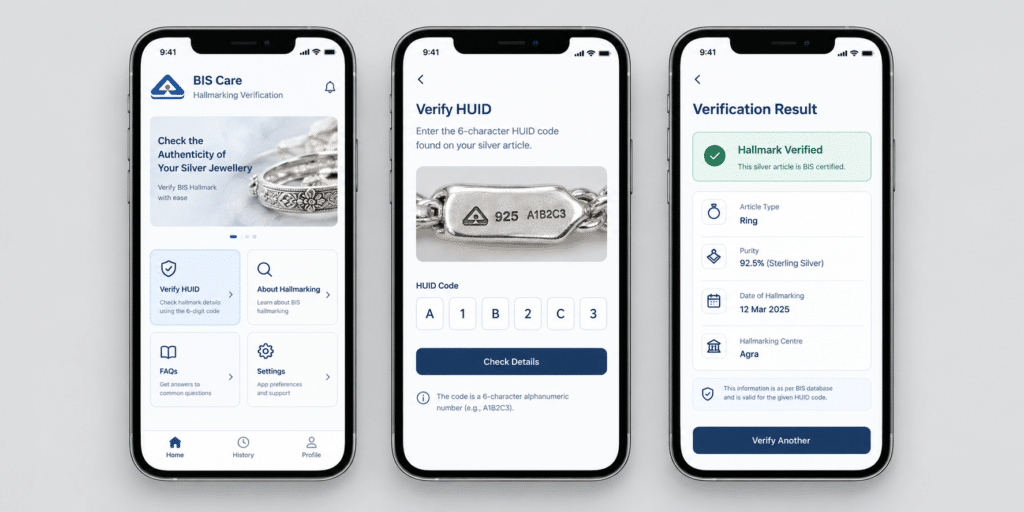
Step by step with the BIS Care app
- Download BIS CARE — the official Bureau of Indian Standards app, on Android and iOS. Do not use a third-party clone.
- Find the six-character HUID on the article. Photograph it zoomed in if the engraving is small.
- Open the “Verify HUID” feature and enter the code.
- Read what comes back: article type, purity grade, hallmarking date, the Assaying and Hallmarking Centre that tested it, and the jeweller registration number.
- Cross-check every one of those against the physical piece and your invoice. The article type must match what you are holding. The purity must match what you are being charged for.
What "Invalid HUID" actually means
If the app returns no record, stop the transaction. Do not accept an explanation about server delays or a new batch.
A valid HUID exists in the BIS database from the moment it is laser-inscribed. There is no lag. No record means the mark was not applied at a recognised centre.
If the details come back but do not match — a chain registered as a ring, or 800 shown when you are paying 925 prices — that is a more serious problem than a blank result, and it is worth reporting. Complaints can be filed through the BIS Care app itself, the online complaint portal, or by email to BIS.
What silver hallmarking costs, and what that tells you about price
Transparency here is useful, because buyers often assume hallmarking adds significant cost. It does not.
Under the BIS (Hallmarking) Amendment Regulations, 2026, which took effect on 14 September 2026, the fee a jeweller pays a recognised centre to hallmark one silver article is Rs 35, with a minimum of Rs 150 per consignment.
The same amendment raised the gold fee from Rs 45 to Rs 75 per article — an increase of around 67% — while leaving silver untouched. The centres themselves pay BIS Rs 3.50 per silver article, with a minimum of Rs 15 per consignment. Taxes are extra.
| Silver | Gold |
Fee per article (jeweller pays AHC) | Rs 35 | Rs 75 (was Rs 45) |
Minimum per consignment | Rs 150 | Rs 200 |
AHC pays BIS, per article | Rs 3.50 | Rs 7.50 |
Changed on 14 Sept 2026? | No | Yes, up 67% |
Hallmarking compulsory? | No, voluntary | Yes, in notified districts |
Two things follow from that Rs 35 figure.
First, the fee is charged per article, not by weight. A heavy pooja lamp and a light ring can attract the same charge. That is why lightweight, low-value silver is the category least likely to be hallmarked — the fee is a far larger share of a small item’s value.
Second, and more useful to you as a buyer: Rs 35 is not a real reason for a supplier to skip hallmarking. On a payal set worth several thousand rupees, it is a rounding error. When a seller tells you hallmarking would make the piece too expensive, the arithmetic does not support them.
There is also no government fee to register as a jeweller with BIS, and registration now carries lifetime validity with no renewal cost. The barrier to compliance is genuinely low.
For jewellers, retailers and wholesale buyers
If you sell silver rather than buy it, the calculation is different — and shorter than most people expect.
Getting BIS registered as a jeweller
- Apply through the BIS portal at manakonline.in. There is no government fee for jeweller registration and the certificate has lifetime validity with no renewal.
- Specify silver explicitly. If you are already registered for gold, check that your existing registration covers silver articles.
- Your recurring cost is the per-article hallmarking fee at a recognised centre — Rs 35 for silver, minimum Rs 150 per consignment.
- Send articles in batched consignments. The Rs 150 minimum makes single-piece submissions inefficient.
- Around 230 centres handle silver across 87 districts, so plan for transit time if you are not near one.
If you are still setting up, our guide to starting a wholesale silver business covers sourcing, margins and supplier verification in more depth.
The five-line invoice check before you accept a bulk consignment
We give this checklist to every new B2B customer. Run it on any supplier, including us.
- Purity grade stated numerically — 925, not “pure silver”.
- Net silver weight separated from stone, enamel or thread weight.
- Making charges itemised separately from metal value.
- HUID numbers listed for hallmarked articles, verifiable in BIS Care.
- GST and the supplier’s registration details shown in full.
A supplier who cannot produce all five is not necessarily dishonest. But they are giving you nothing to hold them to, and in a metal priced by fineness, that is the whole ballgame.
Frequently Asked Questions
Is silver hallmarking mandatory in India?
No. Silver hallmarking is voluntary as of September 2026. HUID is mandatory on silver that a jeweller chooses to hallmark, but hallmarking itself is not compulsory. BIS has signalled that a mandatory framework is being prepared, without confirming a date.
What does the 925 hallmark mean on silver?
It means the article is 92.5% pure silver, with the remaining 7.5% usually copper for strength. When it appears alongside the BIS mark and a HUID, it means a recognised centre tested and certified that figure.
Is 92.5 silver the same as sterling silver?
Yes. 925, 92.5% and sterling silver all describe the same alloy. The number is expressed in parts per thousand, the percentage is the same figure, and sterling is the traditional trade name.
Does all silver have a hallmark?
No. Because hallmarking is voluntary, plenty of legitimate silver in the Indian market carries no BIS mark — particularly older pieces and lightweight items. Unhallmarked does not mean fake, but it does mean unverified.
Can a 925 silver stamp be fake?
Yes, easily. A “925” stamp on its own is a claim by whoever made the piece. What is very difficult to fake is a HUID, because it has to exist in the BIS database to verify. That is precisely why the system moved to HUID.
How much does it cost to hallmark silver in India?
Rs 35 per article, with a minimum of Rs 150 per consignment, payable by the jeweller to a recognised Assaying and Hallmarking Centre. This rate was left unchanged in the September 2026 amendment that raised the gold fee to Rs 75.
What is the difference between 925 and 999 silver?
999 is fine silver at 99.9% purity — used for coins and bars, and too soft for daily-wear jewellery. 925 is sterling at 92.5%, alloyed for durability. 999 was newly added as a recognised hallmarking grade in the 2025 revision.
How do I check a silver hallmark online in India?
Download the official BIS Care app, open Verify HUID, enter the six-character code from the article, and compare the returned article type, purity, date, centre and jeweller details against the physical piece and your invoice.
The bottom line
Silver hallmarking in India is voluntary, and a great deal of published advice gets that wrong. What is not optional is HUID — every piece hallmarked since September 2025 carries one, and you can verify it in under a minute for free.
Adoption more than doubled in a year without any legal compulsion, which tells you where this is heading. The buyers and retailers who treat a hallmark as standard now will not have to change anything when the rules catch up.
At Hari Silvears we have been manufacturing and supplying silver from Madurai since 1963. Purity is not a marketing line for us — it is what our wholesale customers audit us on, every consignment.