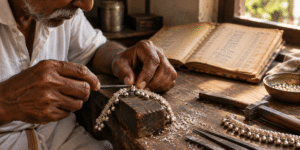
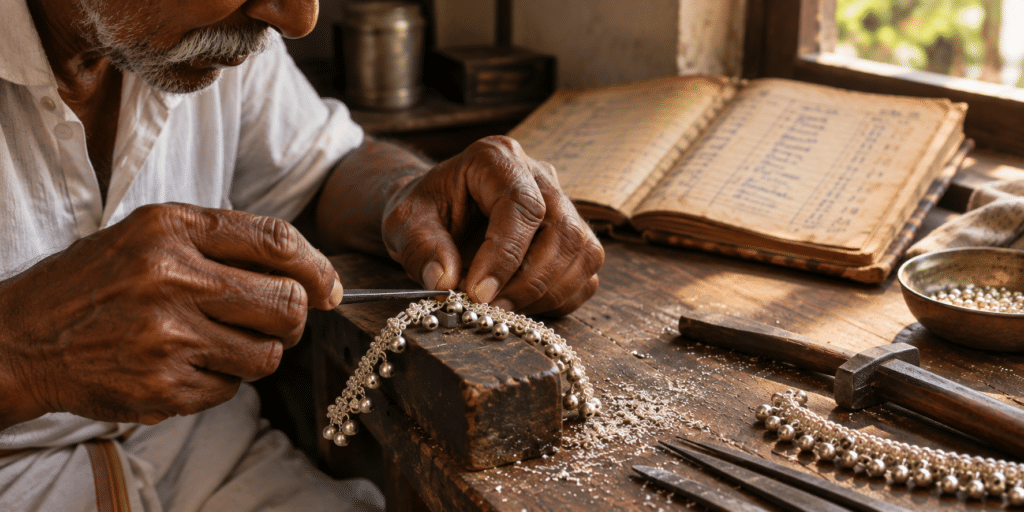
Walk down South Masi Street in Madurai before eight in the morning, and you’ll hear it before you see it — the soft, rhythmic tap of a hammer shaping silver wire into a payal. That sound has echoed from the same family workshop for 60 years.
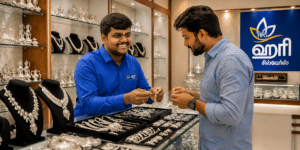
In 1963, Mr. A.K. Jeganathan Chettiyar started a small counter in Madurai buying and selling old silver, silver scrap, and old silk sarees. Six decades and three generations later, that single counter has grown into Hari Silvers — Hari Gold & Silvears — a family silver house that has watched Madurai’s silver trade change around it while holding on to the one thing that hasn’t: hand skill.
This is the story of that 60-year journey, why Madurai remains one of India’s most important silver markets even today, and what the real 2026 market data says about where the craft — and the business of silver — is heading next.
A 60-Year Timeline: How Madurai Silver Craftsmanship Built Hari Silvers
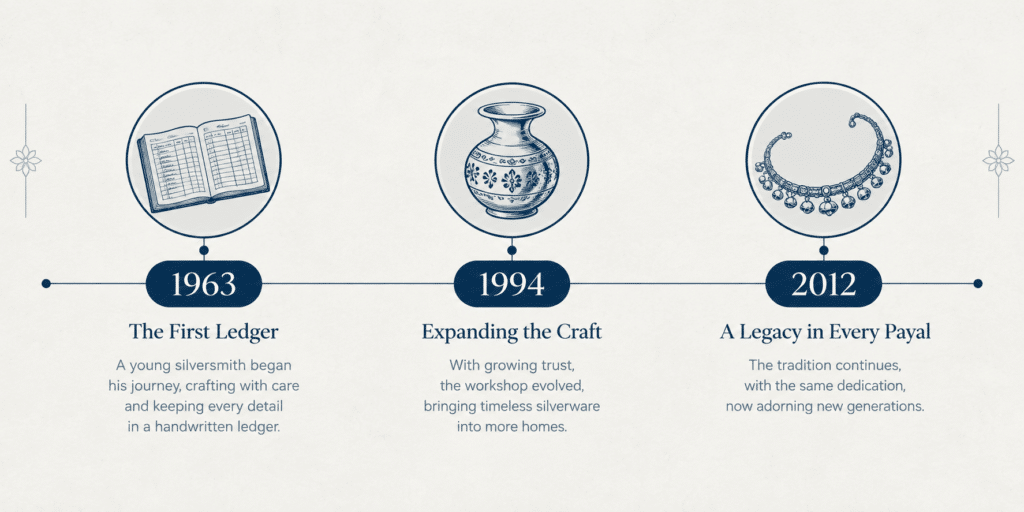
Most “heritage since” claims online are marketing copy. This one has a paper trail — a family business that moved through three distinct phases, each shaped by the person who ran it.
1963 — The First Ledger
Mr. A.K. Jeganathan Chettiyar opened for business buying and selling old silver, silver scrap, and old silk sarees in Madurai — the humble, trade-based model that most silver houses in Tamil Nadu’s temple towns started from. There was no showroom in the modern sense. There was trust, a working knowledge of purity, and a customer base built one transaction at a time.
1994 — From Trading to Wholesale: The Birth of AKJ
Mr. Sudhakran, son of the founder, took the business in a new direction. He started wholesale and retail trading of silver vessels under the name AKJ, moving the family from pure old-silver trading into manufacturing and supplying silverware at scale — vessels, tumblers, and the utensils that Tamil households still exchange as wedding gifts today.
2012 — A New Generation, A New Category
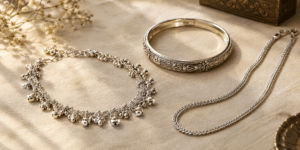
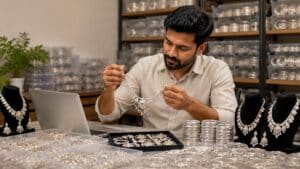
Mr. Balakumar, founder-member of Hari Silvers, joined the family business after completing his engineering degree in 2012. He brought an engineer’s eye to an old trade and initiated what the family calls a drastic shift into the B2B silver payal business across the southern Tamil Nadu market — professionalising sourcing, scaling production, and positioning Hari Silvers as a serious wholesale silver supplier of silver anklets and payal, not just a retail counter.
Why Madurai Is India's Quiet Silver Capital
Madurai rarely gets mentioned alongside Hyderabad or Coimbatore when people talk about India’s jewellery hubs — but its silver trade runs deep, and it’s built on temple geography, not industry.
The city radiates outward from the Meenakshi Amman Temple in four concentric squares of streets. The innermost ring is the Chittirai Streets; the next is Avani Moola Streets, historically the gold market; the third ring is the Masi Streets, home to established silver traders such as Sri Balambigai Jewellery Mart on South Masi Street. This layout isn’t incidental — it’s the same commercial map Madurai’s silver trade has followed for generations.
Demand here is driven almost entirely by ritual and relationship, not industry:
- Temple worship — silver Meenakshi Amman idols, kuthu vilakku lamps, kalasam and pooja bell sets
- Tamil wedding customs — the Chettinad tradition of gifting silver vessel sets, and silver anklets as part of bridal wear
- Festivals — Akshaya Tritiya and Deepavali purchases of silver coins in 999 purity
- Everyday adornment — metti toe rings, kolusu anklets, chains, and bangles
Making charges on silver jewellery in Madurai typically range from 5% to 20%, depending on design complexity — a detail that matters enormously to price-sensitive buyers comparing a wholesale-led brand like Hari Silvers against boutique retail counters.
The Craft Itself: How Hari Silvers' Payal Are Made
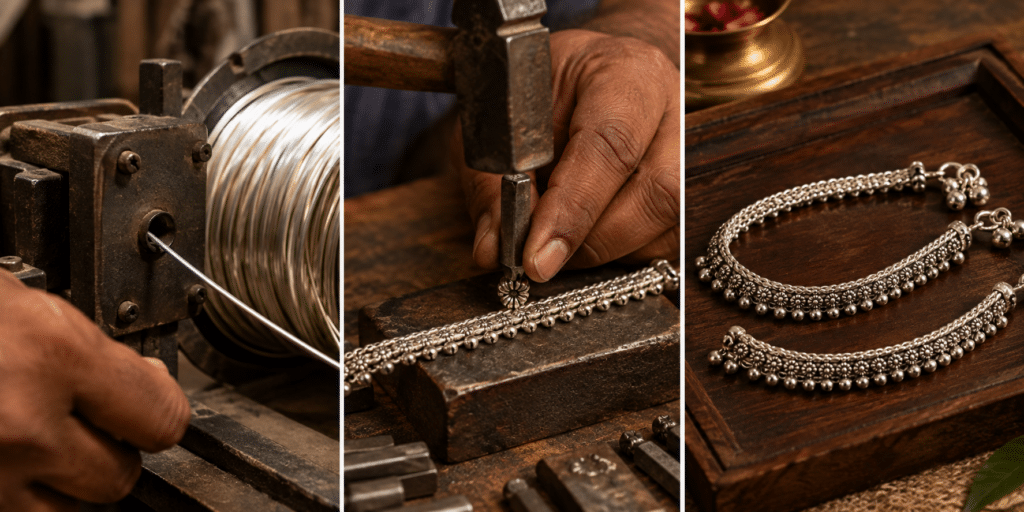
Silver payal-making is a slower craft than most buyers realise. It typically moves through six stages, each still requiring a trained hand even where machines assist:
- Melting and purity testing — raw silver is melted and tested against 925 (sterling) or 999 (fine) purity standards.
- Wire and sheet drawing — the metal is drawn into wire or rolled into sheet, the base material for a payal’s chain or plate.
- Design forming — patterns are hand-stamped, cast, or hand-pierced depending on the design (plain, antique, temple, or bridal).
- Assembly — links, ghungroo bells, or stone settings are joined by hand, piece by piece.
- Polishing and finishing — oxidised, antique, or bright finishes are applied depending on the style ordered.
- Hallmarking and quality check — purity is verified again before the piece leaves the workshop.
This is the part mass manufacturers struggle to replicate profitably at scale, and it’s the reason family-run Madurai silver houses still compete successfully against bigger national brands: a hand-finished payal simply looks and sits differently on the foot than a die-cast one.
Silver by the Numbers: What the Real 2026 Data Shows
Heritage claims are easy to make. Here’s what independently published market data actually shows about silver in India right now.
Metric | 2026 Figure | Source |
Global silver jewellery demand | Forecast down >9% to 178 Moz — lowest since 2020 | Silver Institute / Metals Focus |
Global silverware demand | Forecast down ~17% (price-sensitive, gift-driven category) | Silver Institute / Metals Focus |
Global bar & coin investment demand | Forecast up 20% to 227 Moz — a 3-year high | Silver Institute / Metals Focus |
Global silver market balance | 67 Moz deficit — 6th consecutive year of deficit | Silver Institute / Metals Focus |
Indian jewellery retail market | Grew from USD 50B (FY18) to USD 80B (FY24) | Motilal Oswal Financial Services, via Indian Jeweller |
Festive silver sales (Dhanteras–Deepavali window) | ~220 tonnes sold; silver coins ~60% of that demand | Indian Jeweller market report |
The takeaway for a Madurai heritage brand: rising silver prices are pushing Indian buyers away from heavy jewellery and toward lighter designs and investment-grade coins. That’s exactly the gap a monthly silver saving scheme (see below) is built to close — it lets a customer keep buying silver in small amounts without absorbing a price spike in one lump-sum purchase.
How Hari Silvers Compares to Other Madurai Silver Sellers
A fair competitor read matters more than a flattering one. Here’s how Hari Silvers’ positioning stacks up against the three groups it actually competes with.
Competitor type | Typical strength | Where Hari Silvers can win |
Masi Street heritage jewellers (e.g., Sri Balambigai Jewellery Mart) | Deep local trust, temple-adjacent footfall | 60-year documented family story + B2B payal specialisation + saving scheme content online |
National D2C silver brands (e.g., Kushal’s Fashion Jewellery, jpearls) | Strong e-commerce UX, wide catalogue, national shipping | Authentic craftsmanship storytelling + regional Tamil Nadu SEO + wholesale/B2B pricing |
Marketplace listings (Meesho, Etsy, Amazon sellers) | Lowest price points, huge reach | Verified purity, certified products, and a real, ownable brand history buyers can trust |
Caring for Heirloom-Quality Silver: Tips From Three Generations
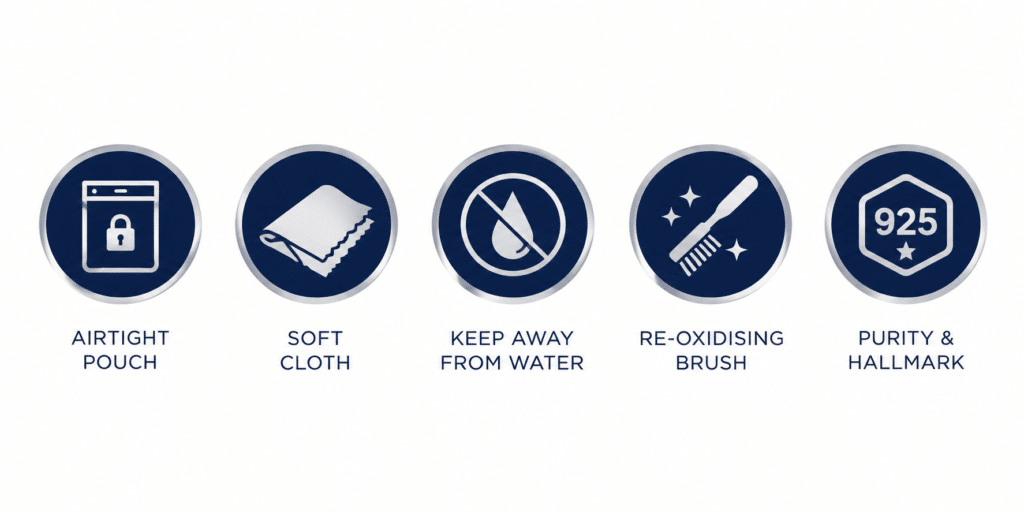
Real experience, not generic advice — this is how the Hari Silvers workshop tells customers to look after handcrafted silver:
- Store pieces in an airtight pouch or box to slow down natural tarnishing from humidity
- Clean with a soft cotton or microfiber cloth — avoid harsh chemical dips on antique/oxidised finishes, which strips the intentional dark detailing
- Remove payal and chains before swimming, bathing, or applying perfume/sunscreen directly onto the metal
- Get antique-finish pieces re-oxidised periodically by the original craftsman rather than a generic polish shop, to preserve the design depth
- Get purity re-verified before resale or exchange — a habit worth keeping given how actively silver is traded in Madurai
Frequently Asked Questions
How old is Hari Silvers?
Hari Silvers traces its roots to 1963, when the founder began trading old silver and silk sarees in Madurai. The business has run continuously across three generations for over 60 years.
Is Hari Silvers' silver certified and hallmarked?
Yes — certified products, quality assurance, and purity verification are core features of the business, in line with standard Indian silver hallmarking practice.
Why is silver jewellery in Madurai priced differently from other cities?
Local making charges (typically 5%–20%), design complexity, and daily silver rates all affect final price — daily rates are best confirmed directly before a purchase, since silver is actively traded and can move several percent in a week.
What makes handcrafted silver payal different from machine-made ones?
Hand-forming, hand-piercing, and manual polishing allow finer, deeper detailing — particularly on antique and temple-style designs — that mass die-casting typically flattens out.
Visit Hari Silvers — Madurai's Silver Story, Still Being Written
Sixty years ago, this business was a single counter trading old silver on Madurai’s streets. Today it’s a three-generation house known across southern Tamil Nadu for B2B silver payal and a customer-first saving scheme — but the craftsmanship underneath hasn’t changed. That’s the story worth telling, and worth searching for.